1
/
of
1
Caux, Marie-Andrée (ed.)
D Major Scale & Arpeggio
D Major Scale & Arpeggio
Regular price
$1.95 USD
Regular price
Sale price
$1.95 USD
Shipping calculated at checkout.
Quantity
Couldn't load pickup availability
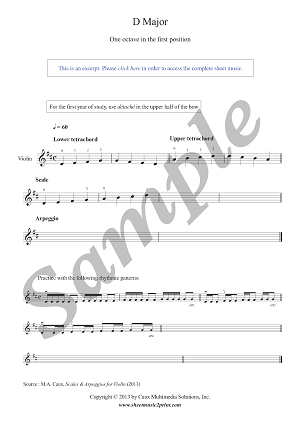
One octave starting on the D string - With tetrachords$$$$$$The scale of D Major is a major scale based on the note D.
It includes the pitches D-E-F#-G-A-B-C#-D.
Its key signature is F#-C#.
Its relative minor is B minor.
This scale of D Major is one of the very first scales to be learned by beginner violinists.
It is to be played in the first position, starting on the open D string.
We recommend that the student learns the lower tetrachord (on the D string) and the upper tetrachord (on the A string) before putting them together to create the D Major scale.
We also suggest a variety of rhythmic patterns to be played on each note.
For better control of the bow by beginners, be sure to use short bow strokes in the upper half of the bow.
This form of détaché bowing is to be played by moving the right forearm only.$$$$$$Duration : 00:50$$$$$$Source : Marie-Andrée Caux, Scales and Arpeggios for Violin (2013).$$$$$$rehnqVZqGCE
Share