1
/
of
1
Handel, George Frideric (1685-1759)
Fuga in G Major, HWV 582
Fuga in G Major, HWV 582
Regular price
$4.95 USD
Regular price
Sale price
$4.95 USD
Shipping calculated at checkout.
Quantity
Couldn't load pickup availability
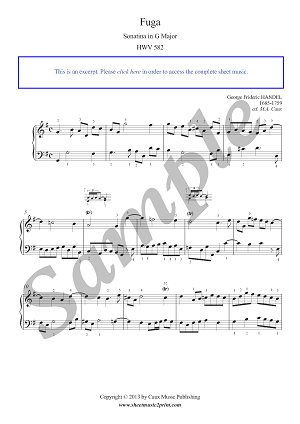
Sonatina - Part of the Aylesford manuscript$$$$$$This Fuga or Sonatina in G Major, HWV 582 by George Frideric Handel was composed ca 1721-1722, during the Baroque period.
It is part of the Aylesford manuscript, where it is entitled Fuga.
The Italian word fuga means an escape, or a flight.
Although Handel's Fuga HWV 582 is not a strictly formed fugue (in the style of Bach's fugues, for instance), it does feature imitation, fleeing and chasing between the two hands.
Please note that although Handel's manuscript does not contain any ornaments, we suggest adding cadential trills to measures 6, 8, 12, 16 and 18.
Our edition thus contains suggestions for realizing these trills in accordance with the performance practice of the Baroque period.
Namely, such trills begin ON the beat, on the upper auxiliary note. More on less repercussions may be played depending on the player's taste and ability.
Please note finally that some editions show an E in measure 5 (7th note, left hand). This could be justified by what is done in measure 7. Handel's manuscript however clearly shows a G.$$$$$$Duration : 00:46$$$$$$Source : George Frideric Handel, Miscellaneous Movements & Dances for Keyboard, HWV 457-586$$$$$$72_yxA36MpQ
Share