1
/
of
1
Bach, Johann Sebastian (1685-1750)
Menuet in B minor, BWV 1067
Menuet in B minor, BWV 1067
Regular price
$5.95 USD
Regular price
Sale price
$5.95 USD
Shipping calculated at checkout.
Quantity
Couldn't load pickup availability
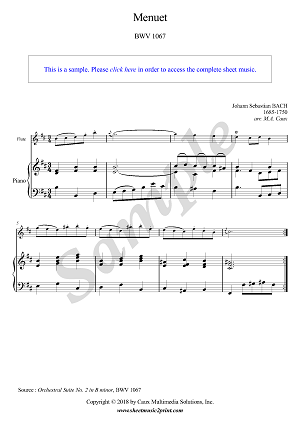
Menuett - Minuet from Orchestral Suite No. 2, BWV 1067$$$$$$This famous Menuet is the sixth of seven movements in Johann Sebastian Bach's Orchestral Suite No. 2 in B minor, BWV 1067.
This orchestral suite was composed in 1738-1739 and it was first published in 1853.
This menuet was originally composed for flauto traverso, two violins, viola and continuo.
This score is an arrangement for flute and piano.
It remains in the original key of B minor.
The flute part is appropriate for Grade 3 flute students.
Please note that the flute part contains suggestions for performing the ornaments (here : appoggiaturas and trills) in accordance with the performance practice of the Baroque period.
Namely, appoggiaturas are played ON the beat, taking up one half of the main note's value.
However, if the main note is dotted, the appoggiatura takes up two thirds of this note's value, which makes the appoggiatura longer than the main note.
Also, in the Baroque period, trills are played ON the beat, beginning on the upper auxiliary note.
More repercussions may be added depending on the player's taste and ability.$$$$$$Duration : 01:19$$$$$$Source : Johann Sebastian Bach, Orchestral Suites & Sinfonia, BWV 1066-1071$$$$$$INTSYFCZYdI
Share